# Trakt vs Letterboxd: Which Movie Tracker Fits How You Watch?

**Published:** June 18, 2026
**Author:** Achriom
**URL:** https://www.achriom.com/blog/trakt-vs-letterboxd

> Letterboxd is a social film diary. Trakt logs your watching automatically across film and TV. A clear breakdown of both, plus a third option if you track more than movies.

**Tags:** movie tracking, trakt, letterboxd, comparison, media apps

---

Trakt and Letterboxd are the two best-known movie tracking apps, and they solve the same problem from opposite ends. Letterboxd is a social film diary: you log a film, rate it, write a review, and your activity lands in a public feed. Trakt runs in the background, scrobbling what you play on Plex, Kodi, or Jellyfin so your history fills itself in across both film and TV.

Pick Letterboxd if you love writing about films and seeing what people with good taste are watching. Pick Trakt if you want automatic tracking, a calendar of what is next, and one record that covers television as well as movies. If you track more than screens, neither is built for that, and the rest of this post covers what to do instead.

## What to look for in a movie tracking app

Before comparing the two, it helps to know what separates a movie tracker you keep using from one you abandon after a week.

**How history gets recorded.** Manual logging gives you control and a reason to reflect on each film. Automatic scrobbling gives you a complete record with zero effort. Most people have a strong preference once they have tried both.

**Film only, or film and TV.** Some trackers are sharp at one screen format. If your watching mixes movies and series, a single record that holds both saves you from juggling two apps.

**Social or private.** A public feed makes logging feel like posting. A private log makes it feel like a journal. Neither is better, but they attract different people.

**What it covers beyond screens.** A movie-only tool is focused. If your taste also runs to books and albums, a film tracker leaves most of it uncatalogued.

**Recommendations.** A good movie tracking app should eventually tell you what to watch next, not just record what you finished.

## Letterboxd

Letterboxd is the gold standard for film logging. It is built around the act of watching a film, rating it, and writing a short review that lands in a public feed followed by people who care what you think.

The diary is the heart of it. You mark films as you watch, leave a star rating, and your activity becomes a timeline you and your followers can scroll. Lists are the other half of the appeal: hand-built collections that surface films you would never find through an algorithm. With over 14 million members, it is the most-cited movie tracker in critic and enthusiast circles, and the place a film like **Past Lives** gets talked about scene by scene.

![Past Lives (2023)](/blog/assets/trakt-vs-letterboxd/past-lives-movie.jpg)

What it does not do is track for you, and it does not do television. Letterboxd is film only. Every entry happened because you opened the app and logged it, and your shows live somewhere else entirely. The free tier shows ads and caps some features behind Pro at $19 a year and Patron at $49 a year. For people who enjoy the ritual of writing about **Everything Everywhere All at Once** the night they see it, that manual effort is the whole point. For everyone else, it slowly becomes a chore.

![Everything Everywhere All at Once (2022)](/blog/assets/trakt-vs-letterboxd/everything-everywhere-all-at-once-movie.jpg)

## Trakt

Trakt is the automation engine of watch tracking. Connect it to Plex, Kodi, Jellyfin, or Emby, and it scrobbles what you play without you lifting a finger, building a complete, timestamped record of both your films and your shows.

The calendar is the feature people stay for. Trakt knows what you follow and tells you exactly when the next thing is out, and its progress tracking always knows the next unwatched episode in every series you have going. Tracking **Dune: Part Two** and a half-finished series in the same place, automatically, is exactly what it is built for. Its API is the most powerful in this space, which is why dozens of other apps and dashboards pull from Trakt under the hood. There is a free tier and a paid VIP tier for unlimited lists and advanced stats.

![Dune: Part Two (2024)](/blog/assets/trakt-vs-letterboxd/dune-part-two-movie.jpg)

The tradeoff is depth of setup and a thinner writing culture. Scrobbling works best through a connected media server. If most of your watching happens in streaming apps on a smart TV, automatic tracking covers less than you would hope and you end up logging films by hand anyway. And where Letterboxd is full of thoughtful reviews, Trakt is a database with a calendar. It is very good at being one, but it is not where the conversation happens.

## A third option if you track more than movies

Both apps assume screens are the thing you want to catalogue. For a lot of people that is one slice of a wider taste. You finish a film, then read the novel it was based on, then fall down a soundtrack rabbit hole, and three different apps each hold one piece of that.

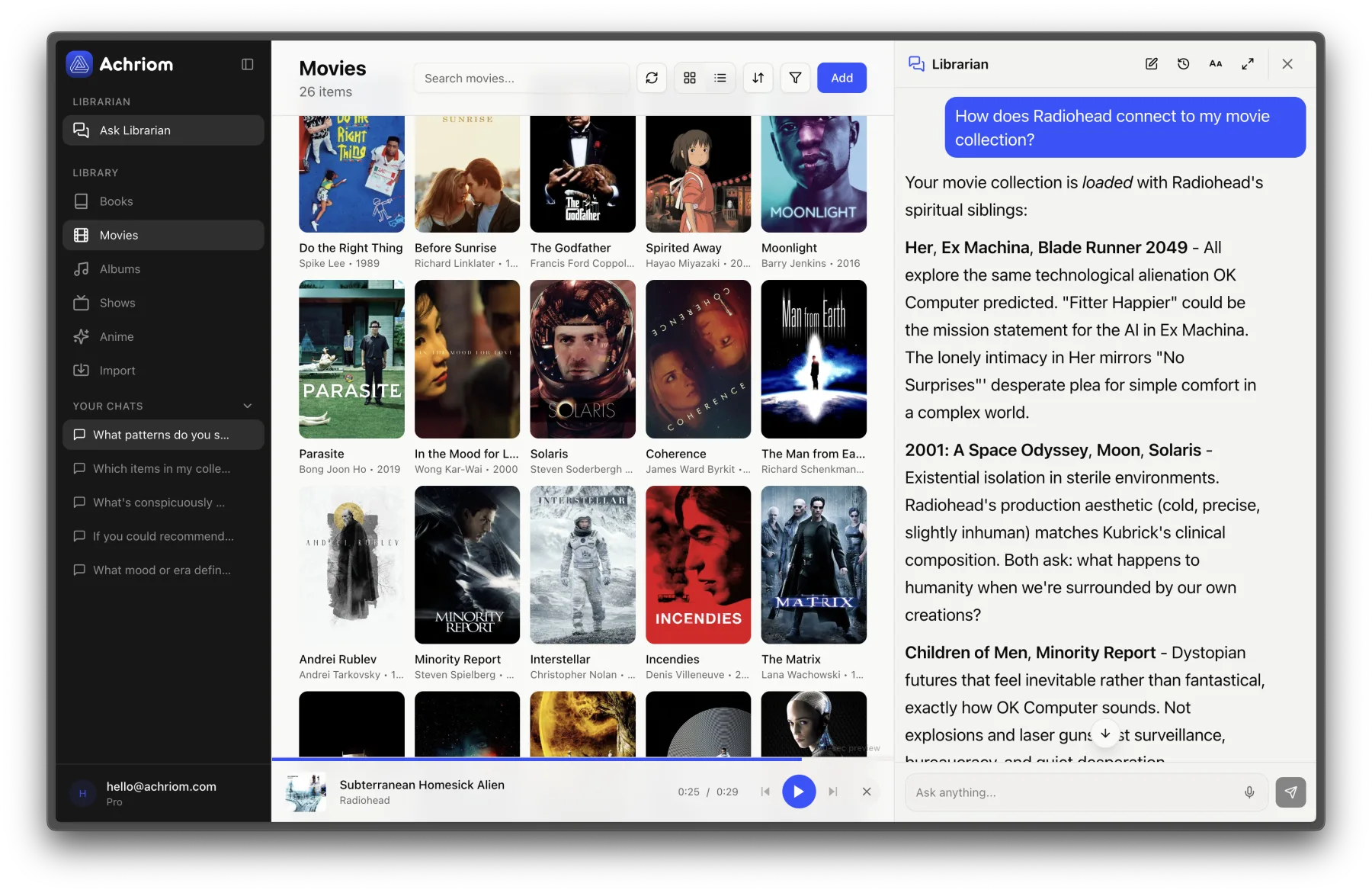
Achriom takes the opposite approach. One library holds your films, TV, books, and albums together, and an AI librarian inside ChatGPT can actually talk about it. You can ask what to read after **Blade Runner 2049**, or why you keep returning to quiet films about memory and distance, and get an answer that draws on everything you have logged, not just your watchlist.

![Blade Runner 2049 (2017)](/blog/assets/trakt-vs-letterboxd/blade-runner-2049-movie.jpg)

It is private by default, with no public feed and no followers. The point is reflection and discovery across your whole taste rather than posting. It does not scrobble from a media server the way Trakt does, so it suits people who want to understand their collection more than they want a hands-off recording of every title.

If movies are the only thing you care to track, a dedicated tool will serve you better. If your film habit is part of a wider taste in books, music, and TV, a cross-media library is the thing single-format trackers cannot give you.

<img class="app-shot" src="/screenshots/app-movies.webp" width="1800" height="1171" loading="lazy" alt="Achriom's AI librarian alongside your movies library in one place" />

<div class="blog-inline-cta">
<p><strong>Want all of it in one place?</strong> Achriom tracks your movies alongside your books, albums, TV, and anime, and an AI librarian shows you the threads between them. That is the part neither Trakt nor Letterboxd can do.</p>
<a href="https://app.achriom.com" data-cta="blog-inline-trakt-letterboxd">Try Achriom free →</a>
</div>

## Trakt vs Letterboxd vs Achriom

| | Letterboxd | Trakt | Achriom |
|---|---|---|---|
| Best for | Writing and sharing film reviews | Automatic, complete watch history | Taste across film, TV, books, music |
| How tracking works | Manual logging | Scrobbling plus manual | Manual, conversational |
| Coverage | Film only | Film and TV | Film, TV, books, albums, anime |
| Social or private | Public feed | Following plus calendar | Private |
| Recommendations | Community-driven | Basic | AI librarian, cross-media |
| Upcoming releases | Limited | Strong calendar | No |
| Price | Free, Pro $19/yr | Free, paid VIP tier | Free tier, in ChatGPT |

## Which should you use

If you love writing about films and want other people to read it, use Letterboxd. The diary, the lists, and the community are the reason it exists, and nothing else here matches that experience for movies.

If you want your history to fill itself in across film and TV and never miss a release, use Trakt. Connect it to your media server, set the calendar, and let it run.

If movies are one part of a broader taste you want to understand, and you would rather have a conversation about your collection than maintain a public profile, look at Achriom. You can [import and organize what you watch](/blog/how-to-track-movies-across-streaming-services/) and then ask your AI librarian what it all adds up to.

Plenty of people use two of these together. Trakt for the automatic record, Letterboxd for the writing, Achriom for the connections across everything they read, watch, and hear.

## The honest answer

Letterboxd and Trakt are both excellent, and they barely compete. One is a place to write about film in public. The other is a place your watching quietly records itself across every screen. Choose based on whether you want logging to feel like journaling or like nothing at all.

The bigger question is whether a movie tracker is even what you are looking for. If your shelves and playlists matter as much as your watchlist, the tool that holds all of it together will tell you more about yourself than any single-format tracker can. That is the gap Achriom fills, and it is worth knowing the option exists before you commit to organizing your life one format at a time. For the full field, see our [breakdown of the best movie tracking apps](/blog/best-movie-tracking-apps/).

## Common questions

**Is Trakt or Letterboxd better for movies?**
Letterboxd is better if you want to write reviews, build lists, and follow a film community. Trakt is better if you want your watch history recorded automatically and a calendar of upcoming releases. Letterboxd is film only, while Trakt also covers TV.

**Does Trakt track movies automatically?**
Yes, through scrobbling. Connect Plex, Kodi, Jellyfin, or Emby and it records what you play, films and shows alike. Watching through streaming apps on a smart TV is harder to scrobble, so some manual logging is still needed.

**Is Letterboxd free?**
Letterboxd has a free tier with ads. Pro removes ads and adds stats for $19 a year, and Patron adds more for $49 a year. Trakt is also free with an optional paid VIP tier.

**Can I use Trakt and Letterboxd together?**
Yes, and many people do. Trakt handles the automatic history and the release calendar across film and TV, while Letterboxd handles reviews and the social side of movies. They serve different needs without much overlap.

**Does Letterboxd track TV shows?**
No. Letterboxd is built for film only. If you want one record that includes television, Trakt covers both, and a cross-media library like Achriom adds books and albums on top.

**What if I track books and music too, not just movies?**
Neither app is built for that. A cross-media library like Achriom keeps film, TV, books, and albums in one place, and its AI librarian can talk about connections across all of them.
<script type="application/ld+json">
{
  "@context": "https://schema.org",
  "@type": "FAQPage",
  "mainEntity": [
    {
      "@type": "Question",
      "name": "Is Trakt or Letterboxd better for movies?",
      "acceptedAnswer": {
        "@type": "Answer",
        "text": "Letterboxd is better if you want to write reviews, build lists, and follow a film community. Trakt is better if you want your watch history recorded automatically and a calendar of upcoming releases. Letterboxd is film only, while Trakt also covers TV."
      }
    },
    {
      "@type": "Question",
      "name": "Does Trakt track movies automatically?",
      "acceptedAnswer": {
        "@type": "Answer",
        "text": "Yes, through scrobbling. Connect Plex, Kodi, Jellyfin, or Emby and it records what you play, films and shows alike. Watching through streaming apps on a smart TV is harder to scrobble, so some manual logging is still needed."
      }
    },
    {
      "@type": "Question",
      "name": "Is Letterboxd free?",
      "acceptedAnswer": {
        "@type": "Answer",
        "text": "Letterboxd has a free tier with ads. Pro removes ads and adds stats for $19 a year, and Patron adds more for $49 a year. Trakt is also free with an optional paid VIP tier."
      }
    },
    {
      "@type": "Question",
      "name": "Can I use Trakt and Letterboxd together?",
      "acceptedAnswer": {
        "@type": "Answer",
        "text": "Yes, and many people do. Trakt handles the automatic history and the release calendar across film and TV, while Letterboxd handles reviews and the social side of movies. They serve different needs without much overlap."
      }
    },
    {
      "@type": "Question",
      "name": "Does Letterboxd track TV shows?",
      "acceptedAnswer": {
        "@type": "Answer",
        "text": "No. Letterboxd is built for film only. If you want one record that includes television, Trakt covers both, and a cross-media library like Achriom adds books and albums on top."
      }
    },
    {
      "@type": "Question",
      "name": "What if I track books and music too, not just movies?",
      "acceptedAnswer": {
        "@type": "Answer",
        "text": "Neither app is built for that. A cross-media library like Achriom keeps film, TV, books, and albums in one place, and its AI librarian can talk about connections across all of them."
      }
    }
  ]
}
</script>
