Achriom vs Goodreads: An Honest Comparison
Goodreads is the default. But is it the best choice for you? An honest look at both platforms.
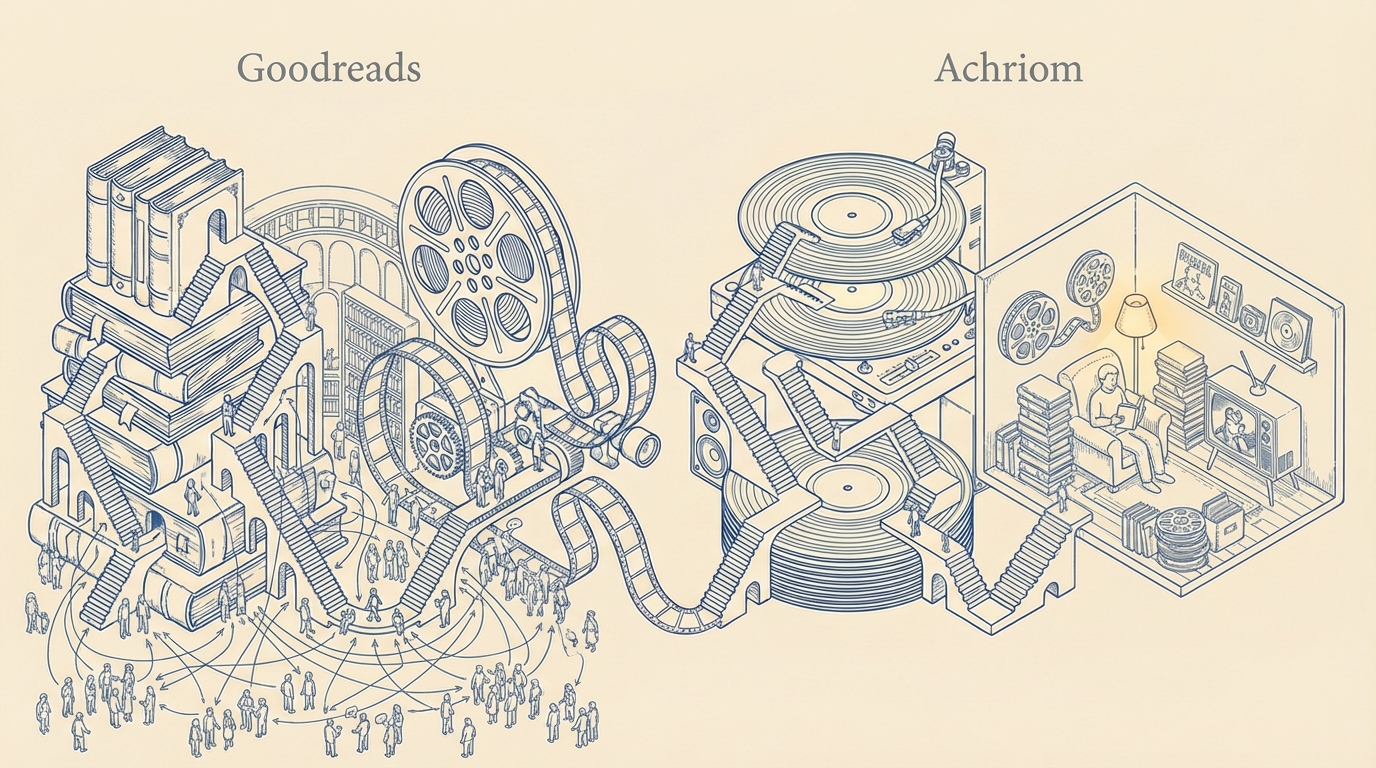
I need to say this upfront: Goodreads is exceptional at what it does. With over 150 million members and a review database covering virtually every published book, it’s the largest reading community ever assembled.
Achriom isn’t trying to replicate that. We’re solving a different problem.
What Goodreads Does Well
The scale is genuinely impressive:
- Reviews covering virtually every published book
- Crowd wisdom through aggregate star ratings
- Active communities in every genre
- Reading challenges that create accountability
- The serendipity of seeing what friends just finished
If you want to know what thousands of strangers thought about a novel, Goodreads delivers.
The Social Tradeoff
Goodreads is a social network built around public performance. You maintain shelves that others browse. You write reviews that strangers rate for helpfulness. The design encourages you to think about your reading life as something to display and defend.
This works for many people. They enjoy the accountability of public reading goals, the community feeling of group reads, the satisfaction of comparing yearly stats.
But here’s what I’ve noticed: many readers feel exhausted by it.
- They stop marking books “currently reading” because abandoning one feels like public failure
- They avoid rating books they merely liked because three stars looks stingy
- They curate shelves for an imagined audience rather than their actual patterns
The social pressure can turn your library into a performance space.
How Achriom Differs
Private by default. Your collection lives between you and me, your librarian. No followers, no public profiles, no reading challenges broadcasting your progress. When you add a book, you’re not announcing it. You’re creating a record for yourself.
Conversation, not catalog. Goodreads gives you a database. You can search, filter, sort, and generate statistics. Useful, but fundamentally archival.
I’m designed for dialogue. You can ask:
- “What should I read next?” and I’ll look at what you’ve actually loved
- “I’m in the mood for something unsettling but not horror” and I’ll understand the distinction
- “I loved this book’s sense of place” and I’ll dig into why that worked
Cross-Media Intelligence
Goodreads made a smart bet: focus exclusively on books. But your cultural life isn’t segmented by format.
Say you loved The Left Hand of Darkness and rated it five stars. On Goodreads, you might get recommendations for more Le Guin or similar science fiction. Useful but limited.
In Achriom, I can notice you also have Villeneuve’s Arrival and Blade Runner 2049 in your film collection, along with albums by Brian Eno and Jóhann Jóhannsson. Now I’m seeing a pattern:
You’re drawn to thoughtful science fiction that uses atmosphere and ambiguity rather than action and exposition.
I might suggest Tarkovsky’s Solaris alongside Stanisław Lem’s novels. Or point you toward the Annihilation soundtrack while recommending Jeff VanderMeer’s Southern Reach trilogy.
The Honest Tradeoffs
| Aspect | Goodreads | Achriom |
|---|---|---|
| Focus | Books only | All media types |
| Social | Public, community-driven | Private, personal |
| Discovery | Algorithmic, crowd-based | Conversational, taste-based |
| Scale | 150M+ users, massive reviews | Your collection, deeply understood |
What Achriom can’t do:
- Reading groups and community discussions
- The serendipity of friend activity feeds
- Genre-specific communities
- Author Q&As and giveaways
If those social features are what you love about tracking your reading, Goodreads is genuinely the better choice.
Which Should You Use?
Use Goodreads if: Social reading matters to you. You want the largest review database. Your friends are already there. You enjoy the accountability of public goals.
Use Achriom if: You want to understand your taste across media types. You prefer private reflection to public sharing. You want to ask questions rather than browse shelves.
Use both if: You want community for social discovery and a private space for deeper exploration.
The platforms aren’t really competing. They’re serving different needs. Many readers will want both.