How to Track Movies Across Streaming Services (2026 Guide)
Track movies across Netflix, Max, Prime, and Apple TV by combining a watchlist app with a logging app. JustWatch, Letterboxd, Trakt, and Achriom each handle different parts.

Tracking movies across streaming services takes two apps, not one. Use JustWatch (or your watchlist app of choice) to find where something streams. Use Letterboxd, Trakt, or Achriom to log what you’ve actually watched. No single app does both jobs well.
If you only want a private record of what you’ve seen, Achriom or Letterboxd is enough. If you want every Netflix and Hulu episode logged automatically, add Trakt. If you keep losing track of which service has a film, JustWatch sits on top of all of it.
Last reviewed: April 30, 2026.
Why one app isn’t enough
The hard part of movie tracking in 2026 isn’t memory. It’s fragmentation.
A typical viewer rotates through four or five services in a month: Netflix, Max, Prime Video, Apple TV+, maybe Hulu or Criterion. Films come and go from each library every month. The movie you wanted to watch last week might be on a different platform now, or behind a rental fee, or pulled entirely.
Tracking has two distinct jobs:
- Forward-looking: what do I want to watch, and where can I stream it right now?
- Backward-looking: what have I already watched, what did I think of it, and what does that say about my taste?
Most people pick one app and try to make it do both. That’s why their tracking habit dies in a month. The forward job and the backward job want different tools.
What to look for
A working setup should cover four jobs across one or two apps:
- Availability lookup: which of your services has this film, and at what cost
- Watchlist sync: the same list, available on phone, TV, and laptop
- Watch history: a log of what you’ve seen, when, and how you rated it
- Discovery: something to recommend the next thing, whether that’s a community, an algorithm, or an AI
Some apps cover one job brilliantly. None cover all four. The trick is picking a pair that overlap in the right places.
JustWatch: availability across services
Use this when: you keep losing track of which service has a film.
JustWatch is a search engine for streaming. Type in a film, and it tells you whether it’s on Netflix, Max, Prime, Apple TV+, or available to rent. It covers 4,500+ services across 140 countries and is free.
The watchlist feature is decent. The tracking features are minimal. Treat it as a lookup tool that happens to remember a watchlist for you. Pair it with a logging app for the backward-looking half of the job.
JustWatch is free and supported by affiliate links to streaming services.
Letterboxd: logging films you’ve watched
Use this when: you want a satisfying ritual for logging films and a community to read reviews from.
Letterboxd is the standard for film diaries. Log a watch, rate it, write a review if you want, scroll through what your friends thought. Over 14 million members. The interface is clean and the community writes thoughtfully.
It does not tell you where to stream things, and it doesn’t connect to your streaming services to log automatically. You’ll log films by hand, which most people find satisfying rather than tedious.
The free tier shows ads. Pro is $19/year, Patron is $49/year. Letterboxd is film-only: your books, music, and TV exist somewhere else.
Trakt: automatic scrobbling
Use this when: you watch a lot of TV and don’t want to log every episode by hand.
Trakt connects to Netflix, Plex, Kodi, and others, and automatically logs what you watch. If you finished an episode of The Bear, Trakt knows. The calendar view shows upcoming episodes for shows you follow.
For films, scrobbling is less useful (you watch fewer of them, and they’re easier to remember), but the same automatic tracking still applies. The limitation: Trakt records consumption without helping you understand it. The interface is dense and dated, and the social features are quieter than Letterboxd’s.
Free tier works for most people. VIP is $30/year and removes ads and limits.
Achriom: cross-media memory
Use this when: you also track books, music, TV, or anime and want them in one library.
Achriom logs films alongside the rest of your media, with a private AI librarian that can talk about all of it. Ask it what to watch tonight if you liked the last novel you read, and it reasons across your full collection rather than just your film history.
It does not scrobble from streaming services. It does not have a public community. The value is depth: an AI that remembers what you’ve rated highly across formats and can recommend a film based on your reading taste, or a book based on what you’ve been watching.
Free tier covers unlimited items and 10 AI messages a month. Pro is $9.99/month for 200 messages a month.
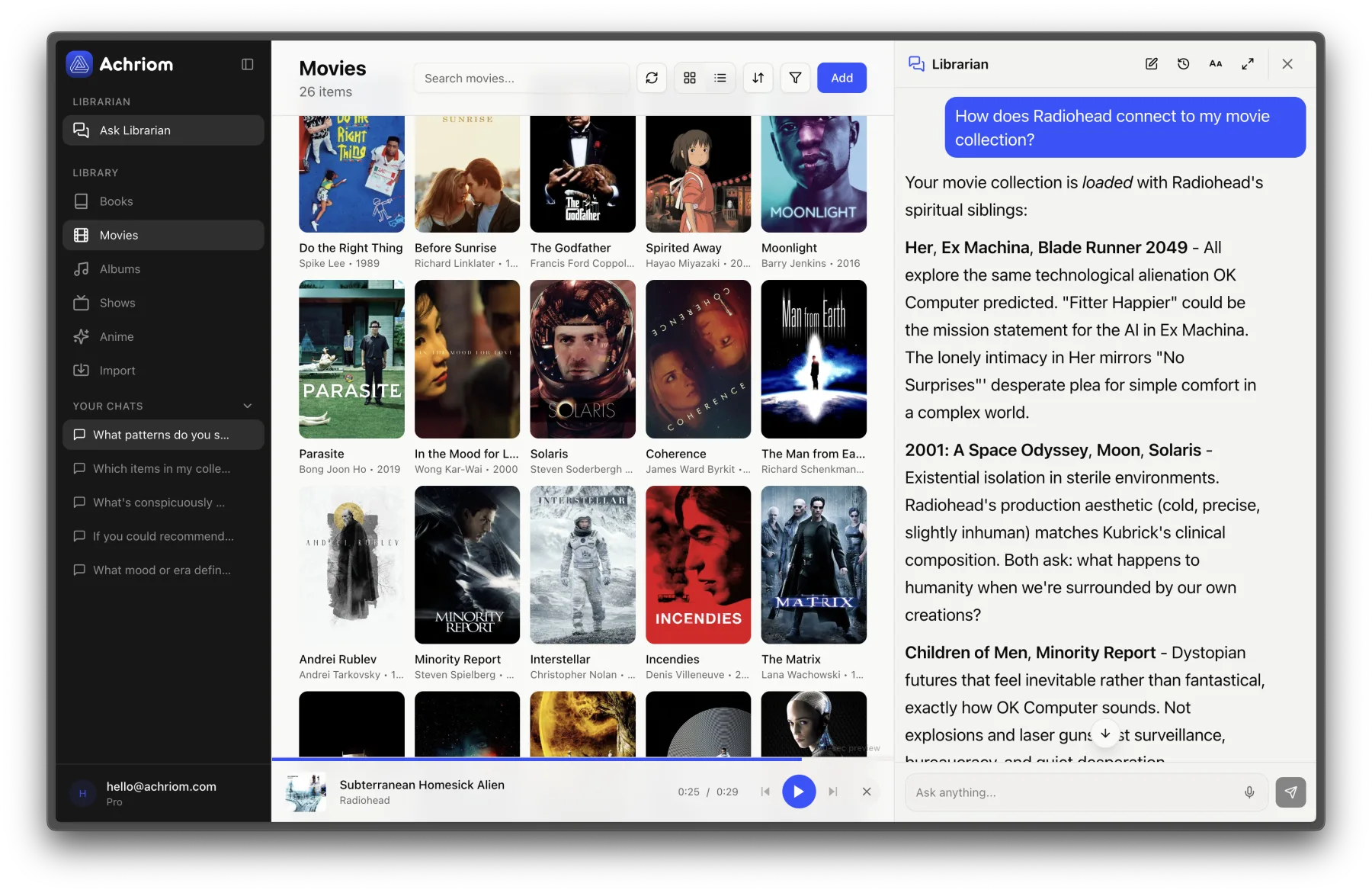
Want all of it in one place? Achriom tracks your movies alongside your books, albums, TV, and anime, with an AI librarian that finds the threads between them. That is the part no single-format tracker can do.
Try Achriom free →How the four apps fit together
| App | Forward (where to watch) | Backward (logging) | Auto-tracking | Cross-media | Price |
|---|---|---|---|---|---|
| JustWatch | Yes | Minimal | No | Films, TV | Free |
| Letterboxd | No | Yes (manual) | No | Films only | Free / $19 / $49 yr |
| Trakt | Some | Yes (automatic) | Yes | Films, TV | Free / $30 yr |
| Achriom | No | Yes (manual or import) | No | Films, books, music, TV, anime | Free / $9.99 mo |
Which combination should you use?
Just want to log films and read reviews: Letterboxd alone. Add JustWatch if you keep losing track of where things stream.
Watch a lot of TV and hate manual logging: Trakt for the auto-scrobbling, plus JustWatch for availability.
Track across formats and care about understanding your taste: Achriom for the library and the AI, plus JustWatch for streaming lookups. Many people add Letterboxd on top for the social ritual.
Just want to know where to watch something tonight: JustWatch. You don’t need a tracker if you’re not going to log anything.
The honest answer
Pick by which half of the job matters more to you.
- Forward-looking only: JustWatch.
- Backward-looking, social: Letterboxd.
- Backward-looking, automatic: Trakt.
- Backward-looking, private and cross-media: Achriom.
Most committed watchers end up with two apps: one for availability, one for memory. The pair that works depends on whether you want your viewing history to feel like a diary, a stat sheet, or part of a wider library that includes what you read and listen to.
If you want to see how Achriom handles film specifically, see the Achriom movie tracker page. For a deeper comparison of logging apps, read Best Movie Tracking Apps 2026 or Letterboxd vs Achriom. For finding new films rather than logging old ones, see Best Movie Discovery Apps 2026.
Common questions
How do I track movies across Netflix, Max, Prime, and Apple TV+?
Use JustWatch to look up which service has a film, and pair it with a logging app like Letterboxd, Trakt, or Achriom to record what you’ve watched. JustWatch handles the forward-looking question (where to stream), and the logging app handles the backward-looking one (what you’ve seen).
Is there one app that does everything?
No. Apps that focus on availability (JustWatch) tend to have weak logging. Apps that focus on logging (Letterboxd, Achriom) don’t connect to streaming catalogs in real time. Trakt comes closest with automatic scrobbling and some availability data, but most people still pair it with JustWatch.
Can I track movies automatically without logging each one?
Trakt is the only mainstream tracker that scrobbles from streaming services automatically (via Plex, Kodi, or supported integrations). Letterboxd and Achriom require manual logging or a one-time CSV import.
What’s the best free way to track movies across services?
Use JustWatch (free) for availability and Letterboxd’s free tier for logging. Achriom’s free tier (unlimited items and 10 AI messages a month) is the option that tracks movies alongside books, music, TV, and anime in one place.
Can I import my watch history from one app to another?
Yes, in most directions. Letterboxd exports diary and lists as CSV from account settings. Trakt accepts Letterboxd imports via third-party tools. Achriom accepts Letterboxd CSV imports directly. IMDb watchlists can also be exported as CSV.
Do streaming services have built-in tracking?
Each service tracks what you watch inside its own walled garden, but they don’t share that data with each other or with third parties. A film you finished on Netflix won’t show up in Prime Video’s history. That isolation is the reason cross-service tracking apps exist in the first place.