Achriom Now Tracks Video Games: A Game Backlog Tracker You Can Talk To
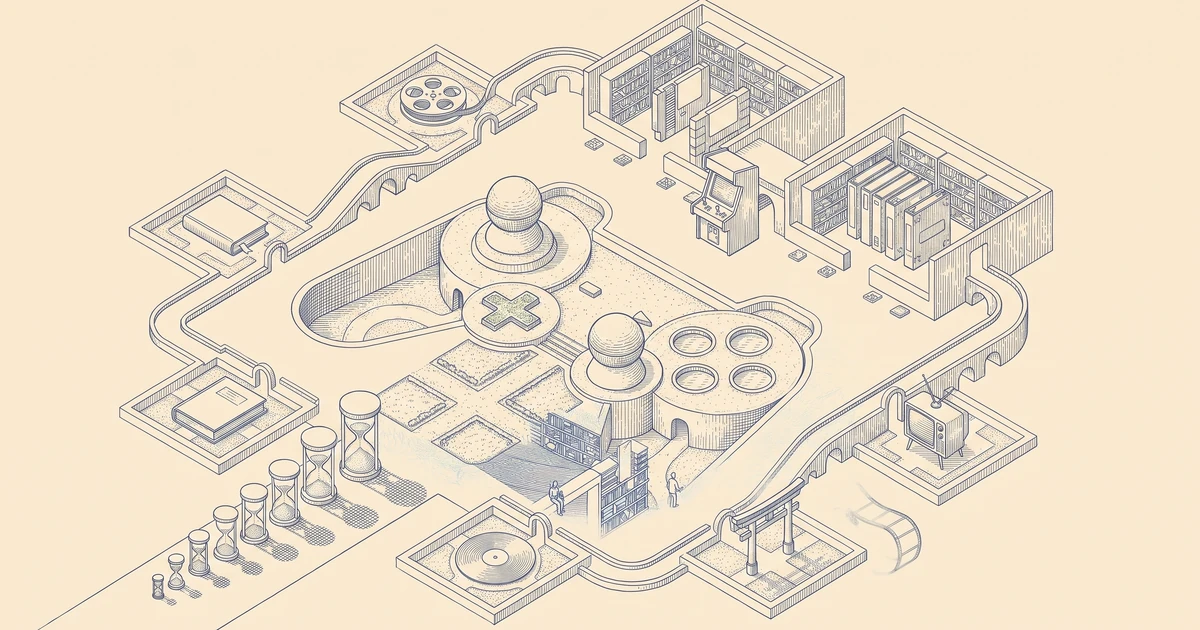
Video games are the seventh media type in Achriom. Every game carries an average time-to-beat, so you can ask what you can actually finish this weekend, and your games sit in one
What can I actually finish this weekend?
That question has an answer now. Video games are the seventh media type in Achriom, and every game in your library carries an average time-to-beat. The librarian can read your backlog against the hours you actually have and come back with two or three specific games.
Games join books, movies, albums, TV shows, anime, and podcasts in the same library. Metadata comes from IGDB, where Achriom is an official data partner, so a game arrives with its art, its trailers, and its numbers rather than as a title on a blank tile.
Your backlog, measured in hours
A backlog is a list of time commitments you have yet to make. Until you can see that one game runs six hours and the next runs sixty, every entry on the list weighs the same, which is roughly why backlogs stop being useful at around forty games.
Time-to-beat sits on every game in your library, and the librarian can query it. The questions that follow are the ones people actually have:
- What can I actually finish this weekend?
- What is the shortest game in my backlog?
- What order should I play this series in?
- What have I been putting off the longest?
- I loved Disco Elysium. What in my backlog is closest?
Plenty of tools can store an average completion time. Having a conversation with one is the part that has been missing. The librarian is reading your library, so the weekend answer is filtered by hours and by what you actually own, and the play-order answer accounts for which entries in a series are already on your shelf and which are missing.
The last question is the one that tends to surprise people, because the answer draws on your ratings across every media type rather than on what other players clicked.
Getting your games in
Four routes, depending on what your collection looks like.
Search by title. Type “The Witcher 3” and you get one result: the base game. The Game of the Year edition, the Complete Edition, and the regional variants stay out of your way. Edition sprawl is where most game catalogs come apart, so it is where we spent the time. Remakes disambiguate by year, so searching Resident Evil 4 asks whether you mean 2005 or 2023.
Paste a list. The bulk importer takes up to 200 titles at a time, which is the fast path for a digital library. There is no Steam connection yet.
Photograph your cases. If your games are physical, snap a photo of the cases and add them as physical copies.
Just say it. Tell the librarian what you have been playing and it goes in mid-conversation.
What comes with each game
Every game carries cover art, trailers, and screenshots that open in a lightbox, plus the storyline, the developer and publisher, the franchise it belongs to, and that average time-to-beat.
Tracking what you play
Each game takes a play status: To Play, Playing, Played, Saved, On Hold, or DNF. Alongside that you record the platform you own it on, whether the copy is physical or digital, a star rating, notes, and started and finished dates. Replays get logged as replays, which matters for the games you return to every few years.
The DNF status is there on purpose. A game you abandoned at hour nine is real information about your taste, and a tracker that only records completions throws it away.
Games join your taste portrait
Here is the part that only happens when everything lives in one library.
Your games count toward your Taste Portrait and your cross-media stats. The librarian can notice that the games you rate five stars and the novels you rate five stars circle the same preoccupation. It can recommend a film based on what you have been playing, or point you at a game because of the albums you had on repeat last winter.
A game-only tracker has no way to make that connection, because games are all it holds. Achriom keeps the rest of your taste in the same place, which is the only reason the question is answerable at all. If you have spent years logging films on one service, books on another, and games on a third, this is the argument for putting them together.
Games in Claude and ChatGPT
If you use Achriom through the Claude or ChatGPT connectors, games are there too. Your assistant can search for a game, add it to your library, and work through your backlog inside a conversation you were already having. Nothing to reconnect; the tools picked up the new media type on their own.
Where games work today
Games are live right now on the web app at app.achriom.com, in the Android app on Google Play, and in the Claude and ChatGPT connectors. The iOS app will pick them up in a later update. The game tracker page has the full feature rundown and an honest comparison with Backloggd, HowLongToBeat, and Grouvee.
Add a dozen from your backlog and ask what you can finish this weekend. That is the whole demo.
Games metadata is powered by IGDB.com.
New to Achriom? Start with the complete guide, or see what you can ask your AI librarian.