How to Find Patterns in Your Media Collection
A practical guide to discovering the themes, moods, and connections that run through your books, movies, albums, and TV shows.
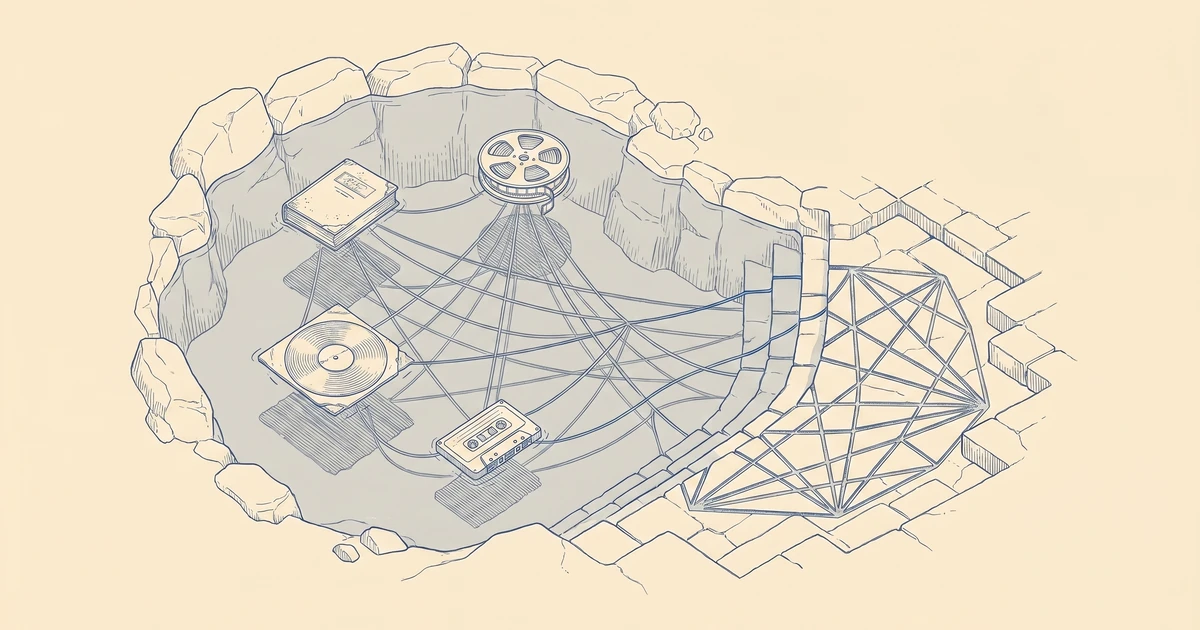
You’ve spent years building your collection. Books on the shelf. Movies you’ve rewatched. Albums you keep returning to. Shows you’ve binged twice.
But have you ever looked at all of it together and asked: what does this say about me?
Here’s how to find the patterns hiding in your media collection.
Step 1: See it all in one place
The first problem is fragmentation. Your books are tracked in one app (or not at all). Your movies in another. Your music somewhere else.
You can’t find patterns if you can’t see the whole picture.
Action: Get everything into one view. You can do this manually with a spreadsheet, or use a tool like Achriom that’s built for cross-media collections.
Step 2: Group by feeling, not genre
Genre is too blunt. “Mystery” includes cozy whodunits and dark psychological thrillers. “Rock” spans three decades and a hundred subgenres.
Instead, think about how things make you feel:
- Pace: Is it slow and meditative, or propulsive and urgent?
- Tone: Hopeful? Melancholic? Darkly funny?
- Ending: Resolved? Ambiguous? Devastating?
- Density: Simple and spare, or rich and layered?
Action: Pick 10 favorites across all media. For each one, write three words describing the feeling, not the plot.
Step 3: Look for repetition
Now scan your feeling-words. What shows up more than once?
You might discover:
- Half your favorites share a “bittersweet” feeling
- You gravitate toward “slow build to catharsis”
- Most of your comfort media is “warm but melancholic”
These are your patterns. The aesthetic fingerprint that shows up regardless of whether you’re reading, watching, or listening.
Step 4: Ask cross-media questions
This is where it gets interesting. Take a favorite from one category and ask:
- “What book feels like my favorite album?”
- “What movie shares the mood of this novel?”
- “What show has the same energy as these songs?”
If you can answer these questions, you’ve found connections that transcend medium.
Action: Try to name one book that “sounds like” your favorite record. If you can, you’re seeing the pattern.
Step 5: Use AI to accelerate discovery
You can do all of this manually. But AI tools are built for pattern recognition at scale.
With Achriom, you can ask questions like:
- “What do my highest-rated items have in common?”
- “What themes show up across my books and movies?”
- “Why do I keep returning to these specific works?”
The AI has read, watched, and listened to your whole collection. It can spot patterns you’d miss after months of manual analysis.
What patterns reveal
Finding patterns isn’t just a party trick. It’s useful:
- Better recommendations: Once you know what you’re actually drawn to, you can find more of it, regardless of genre.
- Self-understanding: Your taste is a mirror. What you choose to consume says something about what you’re seeking.
- Intentional collecting: Instead of accumulating randomly, you can curate deliberately.
Your collection isn’t just a list of things you’ve consumed. It’s a portrait of your inner life, painted over years without you realizing it.
The patterns were always there. Now you can see them.
Ready to discover what connects your collection? Achriom finds the patterns for you.