Where to Start With Anne Carson, This Year's Nobel Winner
Which Anne Carson book to read first after her 2026 Nobel Prize, and an order for the rest, sorted by how much ancient Greek and Latin you want in your reading.
Some links below are affiliate links. As an Amazon Associate, Achriom earns from qualifying purchases. For books we prefer Bookshop.org, which supports independent bookstores.
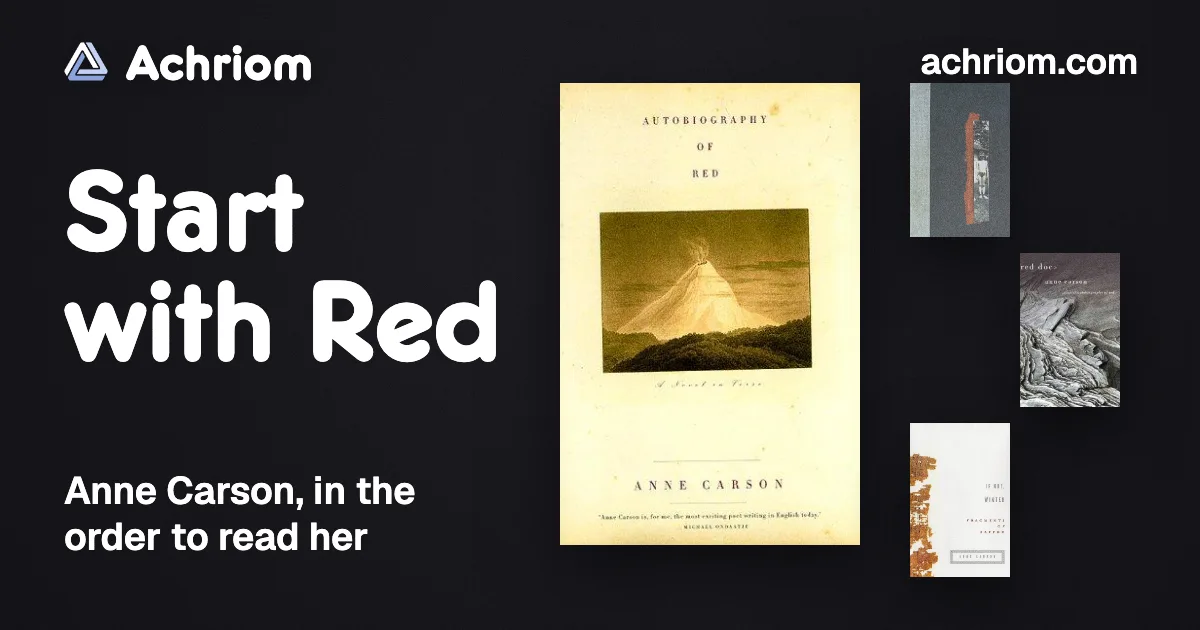
Start with Autobiography of Red. It is a short novel in verse that retells an ancient Greek myth as a love story between two young men, and you don’t need to know any Greek to read it. If you read only one Carson book this year, make it this one.
Carson won the 2026 Nobel Prize in Literature on October 8. The Swedish Academy cited her “bold and inventive oeuvre that, in playful dialogue with the classical tradition, has created new forms for contemporary literature” (WUNC). That sentence is accurate and also tells you nothing about what a Carson book is like to hold, so here is an order based on what you’ll actually be reading.
The ladder, in one look
- Autobiography of Red: the way in. A verse novel, fast, no prerequisites.
- Nox: the most personal book. An epitaph for her brother, built as an object.
- Red Doc>: the follow-up, if you want more Geryon.
- Antigonick: Sophocles’ Antigone in her translation, with drawings.
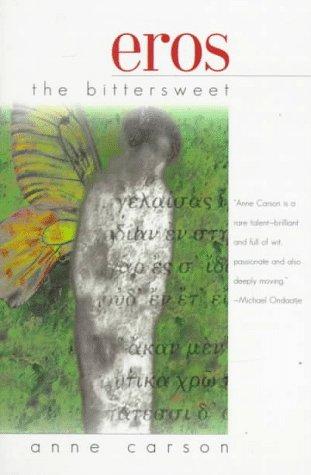
- Eros the Bittersweet: the essays on desire, reworked from her doctoral thesis.
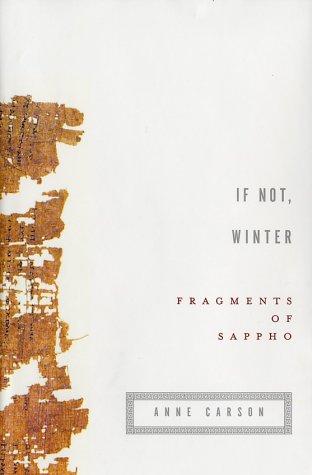
- If Not, Winter: her Sappho, for when the fragments have hooked you.



Steps 2 to 6 aren’t a strict sequence. Pick by how much of the ancient world you want.
Step one: Autobiography of Red

Carson built this book on a fragmentary poem by the Greek poet Stesichorus about Geryon, a red, winged monster killed by Heracles as one of his labors. She flips the point of view. Her Geryon is a teenager with wings, a monster the way an outsider feels like one, and Heracles is the young man he falls for, who breaks his heart (Wikipedia has the plot, which runs from his childhood to a reunion in Buenos Aires and a trip to Peru).
Read it for the story first. The scenes are quick, and the myth is background rather than homework. If the opening material about Stesichorus slows you down, skip ahead to the romance and come back to it later.
You can find it on Achriom’s Autobiography of Red page.
Step two: pick your path
After the first book, the right next book depends on what you liked.
If you want more feeling and no classics: Nox (2010). Carson made it as an epitaph for her brother Michael, who died in Copenhagen. It is built around the Roman poet Catullus’s poem 101, an elegy for his own brother: the sixty-three Latin words of the poem are taken one at a time and defined on the left-hand pages, while the right-hand pages hold her memories, fragments of his letters, photographs and stamps. The book is an accordion of thick paper, folded and kept in a box, so read an edition you can hold if you can. It needs nothing from you except a family (Harvard Divinity Bulletin).
If you want more Geryon: Red Doc> (2013). It is a follow-up to Autobiography of Red, and it has been read as a second elegy, this time for her mother (Wikipedia). Read it only if the first one stayed with you.
If you want a little more of the Greeks: Antigonick (2012). This is her version of Sophocles’ Antigone, the play about a woman who buries her brother against the king’s orders. New Directions published it with text blocks hand-inked on the page by Carson and her collaborator Robert Currie, and translucent vellum pages carrying Bianca Stone’s drawings over the text (source). A later non-illustrated edition came out in 2015. Either way the play is the right size to meet the classics at.
If you want the ideas behind it: Eros the Bittersweet (1986). An essay on desire as the ancient Greek writers saw it, pleasurable and painful at once, built on Sappho’s word glukupikron, “bittersweet.” It moves through Sappho, the Greek novelists and Plato’s Phaedrus, and it grew out of her 1981 doctoral thesis (Wikipedia). It is the right pick if Autobiography of Red left you wanting the argument behind the poem, and the wrong one if you wanted more story.
If you want the source: If Not, Winter (2002). Her translation of Sappho, with the Greek on facing pages. She puts square brackets where the papyrus is torn or missing, so the poems arrive full of gaps, and the gaps are a large part of the experience. It is for readers who already like the way Carson writes.
Other ways in
Some readers come to Carson sideways. The Beauty of the Husband (2001) is subtitled “A Fictional Essay in 29 Tangos” and draws on her first marriage (Wikipedia). Float (2016, Knopf) is 23 chapbooks in a clear acetate case, which you can read in any order, and they mix essays, plays, poems, lists and translations (Publishers Weekly). It suits someone who likes the idea of Carson more than any one of her books. Neither is a first book. Both make more sense after one you’ve loved.
Keep the reading somewhere you can ask it questions
Carson’s own books point at other work: Autobiography of Red rests on Stesichorus, and Antigonick on Sophocles. Achriom lets you keep that next to the rest of what you read and watch. You can keep books, films, shows, albums, anime, podcasts and games in a single library, rate them, add notes and track your progress, so Carson sits next to everything else you’re reading and watching. Its AI librarian answers questions about your own library, and you can reach it in the app, in ChatGPT, in Claude or in Cursor. A good first question is “I just finished Autobiography of Red, what should I read, watch or listen to next from what I already own?”
The free tier has no limit on what you keep and includes 10 librarian messages a month, with no card needed (achriom.com). Your library is private by default, and you can turn on a public profile later if you want to share reviews, lists and a diary.
If your reading already lives in Goodreads, Achriom imports it, and the walkthrough is in how to move from Goodreads to Achriom. If a Nobel announcement has just added six books to your list, see the psychology of the unread pile. And for the idea of letting a librarian plan a stretch of reading from what you’ve already got, there’s I asked my librarian to plan a year of reading from my shelf.
What the other book apps do
You don’t need an app to read Carson, but a list helps once the Nobel pile grows. Goodreads lets you rate and shelve books and follow friends’ reading, and it is the right pick if books and your friends’ shelves are all you want to track. It keeps books. Achriom keeps books alongside films, shows, albums and games, so a Carson reading list can sit next to the Greek-myth films and albums you track, and you can ask a librarian about all of it. For a side-by-side, see the best book tracking apps.
Questions people ask
Where should I start with Anne Carson?
Start with Autobiography of Red, a short novel in verse that retells the myth of the monster Geryon as a modern coming-of-age and love story. You need no Greek or classics background to read it.
Do I need to know Greek mythology to read Anne Carson?
No. Autobiography of Red explains the little you need as it goes, and Nox needs only a family. The books that lean hardest on the classics are Eros the Bittersweet, If Not, Winter and Antigonick, which is why they come later.
What did Anne Carson win the Nobel Prize for?
The Swedish Academy awarded the 2026 Nobel Prize in Literature to Anne Carson on October 8 for her bold and inventive oeuvre that, in playful dialogue with the classical tradition, has created new forms for contemporary literature.
Is Anne Carson a poet or a novelist?
Both, and an essayist, translator and classicist. Her books mix verse, prose, dialogue and translation, and the form changes from one to the next: a verse novel, an accordion-fold book in a box, a set of chapbooks in a case, a translation of Sappho.
In what order should I read Anne Carson?
Autobiography of Red first. Then Nox if you want something personal, Red Doc> if you want to stay with Geryon, and Antigonick, Eros the Bittersweet and If Not, Winter as you want more of the classics.